Car Comparison
2024 Subaru Solterra vs. 2024 Volkswagen ID.4
By Brady Holt
Recent Articles
Popular Makes
Body Types
2023 Toyota Sequoia Platinum ・ Photo by Brady Holt
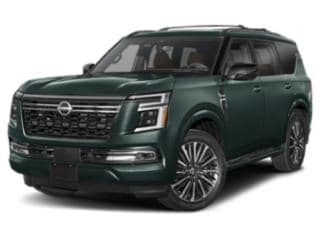
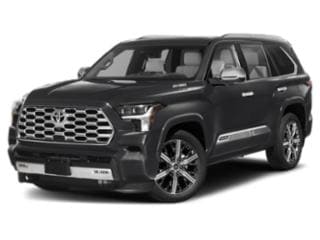
With a full-size SUV, you don’t need a luxury brand to get a luxury experience. Just look at the 2026 Nissan Armada and 2026 Toyota Sequoia. Both have richly finished interiors; huge, cushy seats; and tons of high-end amenities. Both also cost luxury-level prices – roughly $60,000 to start and rising quickly from here.
Part of the premium you’re paying for is heavy-duty construction. These aren’t car-based crossover SUVs. They’re genuine trucks that can go off road and tow large trailers.
For this review, we tested both the Armada and the Sequoia. And while some folks may have different priorities than we do, we had no trouble choosing a winner between the two. Keep reading as we compare the Armada and Sequoia in eight categories, then tell you which one we picked. We’ll also discuss a few other competitors so you can see which full-size SUV is best for you.
The 2026 Nissan Armada starts at $58,840 for the base SV model with rear-wheel drive. The popular four-wheel drive option costs an extra $3,000, and every Armada adds a mandatory $2,190 destination charge.
The 2026 Toyota Sequoia costs even more. The cheapest model, the SR5, costs $64,025 plus a similar $2,095 destination charge. And four-wheel drive is a $2,000 upcharge. What’s more, the Armada SV includes leatherette upholstery while the pricier Sequoia SR5 comes with cloth.
Both SUVs can soar in price with options. Our tested off-road-ready Armada Pro-4X topped $80,000. And the top-of-the-line Sequoia Capstone can approach $90,000. Whether you want to maximize your luxury or minimize your expenses, the Armada tends to cost thousands less than the equivalent Sequoia.
Winner: Nissan Armada
2026 Nissan Armada Pro-4X ・ Photo by Brady Holt
The Nissan Armada was fully redesigned last year, and Nissan kept it simple. Sure, you’ll find a couple of details like a rear lightbar and a “floating roof” effect that connects the side windows to the rear windshield. But this is a big, purposeful box. No swoops or bulges along the sides. Big windows and a straight-vertical rear end. The Armada is sold in other parts of the world as the Patrol – a workhorse off-roader in the vein of a Toyota Land Cruiser. And that’s clear in the Armada's upright shape.
The Toyota Sequoia, last redesigned in 2023, pairs the nose of a Toyota Tundra pickup with a sportier, more hunched-forward shape than the Armada. It’s styled to look dynamic and aggressive rather than upright and solid.
Both trucks come in a choice of luxury-focused and off-road-focused trim levels, and the Armada even adds a performance-focused NISMO model this year.
Rather than declaring a winner between the Armada and Sequioa’s different approaches, we’ll let you pick your preferred look.
Winner: Tie
2023 Toyota Sequoia Platinum ・ Photo by Brady Holt
We’ll declare another tie in the cabin, but for a different reason.
Now, you’ll still get to make up your own mind about two very different dashboard designs. Nissan gives you a digital-focused experience, with an information-packed 12.3-inch touchscreen sharing a wide panel with a 12.3-inch digital gauge cluster. And its high center console and flowing dashboard give a sporty, car-like vibe rather than an all-business truck look. Toyota does the opposite, as the Sequoia shares its dash with the Tundra. Toyota gives you a big 14-inch touchscreen popping out from the dashboard as a distinct element, and its graphics are simple and austere.
Here are the other differences. Toyota makes you buy an upper-trim Sequoia to get rich interior finishes, while every Armada looks and feels opulent – almost as nice as its luxury-branded cousin, the Infiniti QX80. On the flip side, some of the Armada’s controls are harder to use. We don’t love how the Sequoia makes you change views on the touchscreen rather than, say, showing a GPS map next to information about the song you’re listening to. And you need to buy a subscription to use the factory nav system. But unlike in the Nissan, everything is simple to use. The Armada has some tiny and hard-to-reach touchscreen functions. And even its physical controls are clustered tightly together, so it takes an extra second to identify the right one.
Each big SUV has some interior advantages and its own distinctive style. But neither walks off with a clear win.
Winner: Tie
2023 Toyota Sequoia Platinum ・ Photo by Brady Holt
The Armada does pull clearly ahead when you load it up with passengers. While both SUVs have comfortable front and second-row seats, the Sequoia’s tiny third row falls below the standard we’d expect from a full-size SUV. Between its bulkier rear suspension and a battery for its gas-electric hybrid powertrain – we’ll discuss that later on – the Sequoia has limited third-row legroom and a low cushion. The third row does adjust fore-aft, but scooting it back takes up almost all the cargo hold.
If you’re looking for a full-size SUV because you love a big king-of-the-road feel, not because you need space for lots of passengers, the Sequoia does fine. But when you really want to fit seven or eight people inside, the Armada – while not the roomiest SUV on the market either – does better.
Winner: Nissan Armada
2026 Nissan Armada Pro-4X ・ Photo by Brady Holt
The Armada’s spaciousness advantage continues with its cargo capacity. As we mentioned, sliding back the Sequoia’s third row robs most of its cargo space, leaving just 11.5 cubic feet. That’s a couple of inches of floor space, stacked to the ceiling. Sliding the third row forward opens up a more competitive 22.3 cubic feet, edging out the Armada’s 20.4 cubic feet behind its roomier fixed-position third row.
Start folding down seats, though, and the Nissan’s advantage grows. The Sequoia’s rear seats don’t fold flush with the cargo floor, creating a high ledge that reduces cargo space and makes it harder to load heavy items. You can install a panel that plugs the gap between the folded third row and the rear of the vehicle, which at least makes it easier to slide things in and out. By the numbers, the Sequoia has 49 cubic feet of cargo space with the third row folded and 87 cubic feet behind the front seats. That’s more like a mid-size crossover than a typical full-size SUV. The Armada has 56 and 97 cubic feet, respectively, fitting more of your stuff inside. And its seats fold easily flat with no fuss and with a lower cargo floor.
The Sequoia can tow a heavier trailer. Depending on the trim level, it’s rated to pull up to 9,520 pounds, depending on the trim level, versus the Armada’s 8,500 pounds. But overall, the Armada wins this category.
Winner: Nissan Armada
2026 Nissan Armada Pro-4X ・ Photo by Brady Holt
We mentioned that the Armada and Sequoia are both traditional truck-based SUVs, not car-based crossovers. It’s how their towing capacity is nearly twice that of many three-row crossovers. On the flip side, it means you don’t get the effortlessly handlng of a crossover like a Nissan Pathfinder or Toyota Grand Highlander.
Even within this context, the Sequoia has a bumpier ride and slower handling responses than the Armada – so the Nissan wins this category. That’s likely due to the Sequoia’s solid rear axle versus the Armada’s independent rear suspension. (This tradeoff contributed to the Toyota’s higher towing capacity.) Our chief complaint with the Armada is that the steering feels unnaturally heavy at low speeds; the Sequoia made it easier to spin the wheel while parking. On the other hand, the Armada has more precision at higher speeds.
Both the Armada and Sequoia come with mighty turbocharged V6 engines. The Armada’s total output is 425 horsepower and 516 lb-ft of torque (the new Armada NISMO has 460 hp), and the Sequoia makes 437 hp and 583 lb-ft when paired with an electric motor. Both trucks should reach 60 mph in around 6 seconds.
Winner: Nissan Armada
2026 Nissan Armada Pro-4X ・ Photo by Brady Holt
We’ve mentioned that the Sequoia is a hybrid – pairing a gasoline engine with an electric motor. Forget Prius-level fuel savings; this is still a huge and powerful truck. But the Sequoia does get better gas mileage than the Armada.
In EPA testing, the Sequoia returns 21 mpg in the city, 24 mpg on the highway, and 22 mpg with rear-wheel drive and 19 mpg city, 22 mpg highway, and 20 mpg combined using four-wheel drive. That compares with 16 mpg city, 20 mpg highway, and 18 mpg combined for rear-drive Armadas; 16 mpg city, 19 mpg highway, and 17 mpg combined for most 4WD models; and 15 mpg city, 18 mpg highway, and 16 mpg combined for the off-road Pro-4X model like our test vehicle.
In our own non-scientific testing, the gap narrowed but the Toyota still came out clearly ahead. Our Sequoia Platinum 4WD averaged 18 mpg, while we got 16 mpg in our Armada Pro-4X. Both can use regular-grade fuel, though the Armada NISMO needs premium.
Winner: Toyota Sequoia
2023 Toyota Sequoia Platinum ・ Photo by Brady Holt
The 2026 Toyota Sequoia has some compelling advantages. It looks sporty for a giant SUV, it has a user-friendly interior, it has a standout towing capacity, and it uses relatively little gas for such a big, powerful, and capable SUV.
Trouble is, the Sequoia drives like a huge SUV and is priced like a huge SUV, but it’s not roomy for a huge SUV. It’s fine if you need a comfortable tow rig or love a big-car feel and don’t have a large family. But when you need to use the third-row seat, passengers will be uncomfortable and cargo space is limited.
The 2026 Nissan Armada is our pick. It’s the more well-rounded full-size SUV. It’s more comfortable to drive, it’s more comfortable to be in, it has more space, it has richer interior materials, and it costs thousands of dollars less. You’ll give back some of that cost savings at the gas station over time, and it can’t tow quite as much. But unlike the Sequoia, it checks all the boxes for a full-size SUV – and for less money.
Winner: Nissan Armada
2026 Nissan Armada Pro-4X ・ Photo by Brady Holt
The Sequoia and Armada face some excellent competitors as well. The Chevrolet Tahoe, Ford Expedition, and Jeep Grand Wagoneer all have more passenger and cargo space than either the Nissan or the Toyota. They all cost more than the Armada, but they all have at least one engine option that matches or beats its gas mileage.
The Tahoe has the worst gas mileage of the class unless you pay extra for its class-exclusive diesel option. The Expedition’s controls have become distractingly difficult to use. And the Grand Wagoneer, despite being a Jeep, is the only member of its class without a focused off-road trim level.
2025 Ford Expedition Max Active ・ Photo by Brady Holt
Car of the Day
Resources
©2026 AutoWeb, Inc. All Rights Reserved.
Some content provided by and under copyright by Autodata, Inc. dba Chrome Data. © 1986-2026.